 |  |  |
|---|---|---|
 |  |  |
 |  |  |
 |  |  |
 |  |  |
 |  |  |
 |  |  |
 |  |  |
 |  |  |
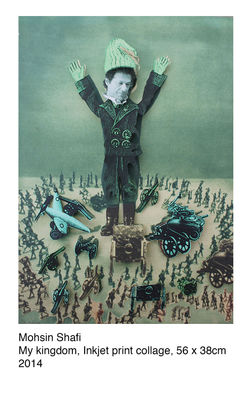
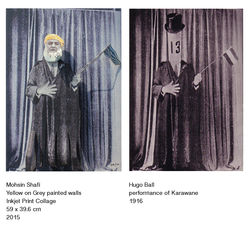
From the get-go ‘Sadaism – Siyasat Series’ ( 2014-2015) is an exercise in appropriation. Adapting Dadaist texts and manifestos, reproduced almost exactly, I replace the word Dada with my own tongue-in-cheek manifestation of the highly politically charged 20th century movement: Sada. “I believe what we call Sada is foolery, foolery extracted from the emptiness in which all the higher problems are wrapped…” With the change of a singular alphabet, Hugo Ball’s words become My own, their context shifts instantaneously, their ownership and significance turns on its head. ‘Sada’ of course refers to the Punjabi word for ‘ours’ – the pun is very much intended.
The term appropriation holds a special relation to American artists of the 1980s, such as Sherrie Levine who reproduced famous works including paintings by French Impressionist Claude Monet as her own, in an attempt to bring them to light in a new set of circumstances and in doing so, endow these familiar images with a new interpretation, a new set of meanings that originated from the time in which they were being produced and understood. This use of the borrowed or found image, object or text is of course not a new one, it is in fact firmly engrained into the structure of the movement to which I refer, i.e. Dadaism, whose artists liberally employed techniques such as collage, photomontage, assemblages and what would come to be known as the ‘readymades’, in a direct attack against traditional modes of art-making.
Drawing directly from the works of renowned Dadaist artists such as John Heartfield, Hannah Hoch, Max Ernst and Marcel Duchamp amongst others, I replaced the heads of political figures with those of local politicians. Compared with the extravagant yet essentially mute pelts of scrap paper assembled by Kurt Schwitters, My images are narrative pageants: angry, painful, acerbic diatribes that shatter orthodox wisdoms on society, political hierarchies and gender. I try to make satirises politicians, perhaps, because it’s so richly legible in terms of contemporary cultural politics. But My real target is the warp and weft of society itself. In The bitterness which opens laugh on all that has been made consecrated, forgotten in our society, in our brain, in our habits.